By Syd Weigand
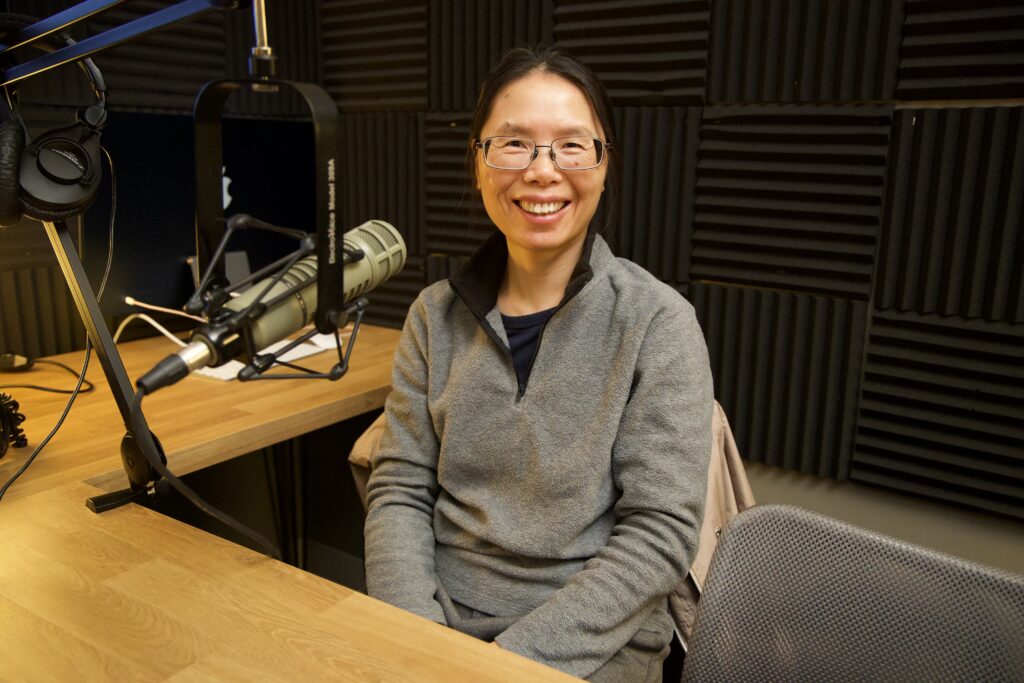
Dr. Xiaorong Lin in the Georgia on Your Mind studio at Grady College at the University of Georgia.
When most people think of fungal infections, they picture benign conditions such as dandruff or athlete’s foot. For immunocompromised individuals, the reality is much more dangerous. Cryptococcus neoformans is a fungal pathogen with a 70% mortality rate. Each year, 15% of all AIDS patients are lost to this pathogen, and the current treatments are ineffective and painful. Dr. Xiaorong Lin has dedicated her life to saving people from this infection, and her lab is revolutionizing the way we fight it.
Dr. Lin joined the Georgia On Your Mind team in the studio for Season 3: Built By Bulldogs to discuss how her time studying at UGA shaped her career and inspired the groundbreaking research she conducts today.
Dr. Lin knew from an early age that she was interested in a career in science. She earned her undergraduate and master’s degrees in Chemical Engineering at Dalian University in Liaoning, China. When she arrived at the University of Georgia, her goal was a Ph.D. in Plant Biology, but when her mentor Michelle Momany introduced her to mycology, she immediately fell in love.
Dr. Lin found her passion in the study of Cryptococcus neoformans. After earning her Ph.D. in 2008, she traveled to Texas A&M to establish the Lin Lab. She spent years studying the pathogen and developing an understanding of the way it affects immunocompromised individuals. At the time, the only therapies against Cryptococcus infection were spinal taps and drugs with devastating side effects, and Dr. Lin felt strongly that those with the infection deserved a more humane solution.
In 2017, Dr. Lin was able to bring the Lin Lab back to UGA. She continued her work here with the help of old friends and mentors, and she has since used the resources of the UGA Fungal Biology group to make great strides in her research. Her current endeavor utilizes a two-pronged approach: better prevention and better treatment. The Lin Lab is very close to creating the world’s first ever fungal vaccine; they have recently achieved promising results in the development of an mRNA-LNP vaccine. Dr. Lin has also made significant strides in her mission to improve targeted drug delivery, which will help direct the currently available medicines to destroy the fungal cells while leaving the host’s body intact.
When speaking with Dr. Lin in Episode 3, she shared the sentiment that awareness must be raised for the possible danger of fungal infections. Climate change has the potential to increase the spread of these pathogens, but she does not wish to generate panic. She pointed out that we must also consider that fungi have the potential to do incredible things for us, such as providing models with which we can study aging and cancer treatments.
“ I think that’s why it is very important to actually to study fungal biology… Like people said, you want to keep your friends close, and your enemies closer.”
Dr. Lin’s achievements thus far are commendable, and her prowess and passion are a source of inspiration for scientists and humanitarians alike.
Listen to Episode 3: Medical Mycology, available wherever you get your podcasts.
To explore more of Dr. Lin’s work, visit the Lin Lab’s website.